Why your electric gate has stopped working: the nine usual causes
A gate engineer's checklist for a gate that will not open, stops halfway, reverses, hums or ignores the remote, with what you can safely check yourself before calling.
Nine faults account for the large majority of the repair calls we get in Glasgow. Some you can rule out in five minutes with no tools. Others need an engineer, and forcing the gate in the meantime will turn a cheap fix into an expensive one.
Safety first: never put yourself between the leaves or under a sliding gate, never bypass photocells to make a gate move, and switch off the power at the isolator if the motor is running continuously.
1. Photocells blocked or misaligned
The most common cause of a gate that opens but will not close, or starts to close then reverses. The safety beam across the drive is broken by a wheelie bin, a hedge, a spider's web or pillars that have moved slightly with frost. Look for the small black lenses at knee height on each pillar and clear anything in front of them.
2. Remote battery or lost pairing
If the gate works from the keypad or intercom but not the remote, change the remote battery first. If the LED on the remote lights but the gate ignores it, the remote may need re-pairing to the receiver, particularly after a power cut on some boards.
3. No power
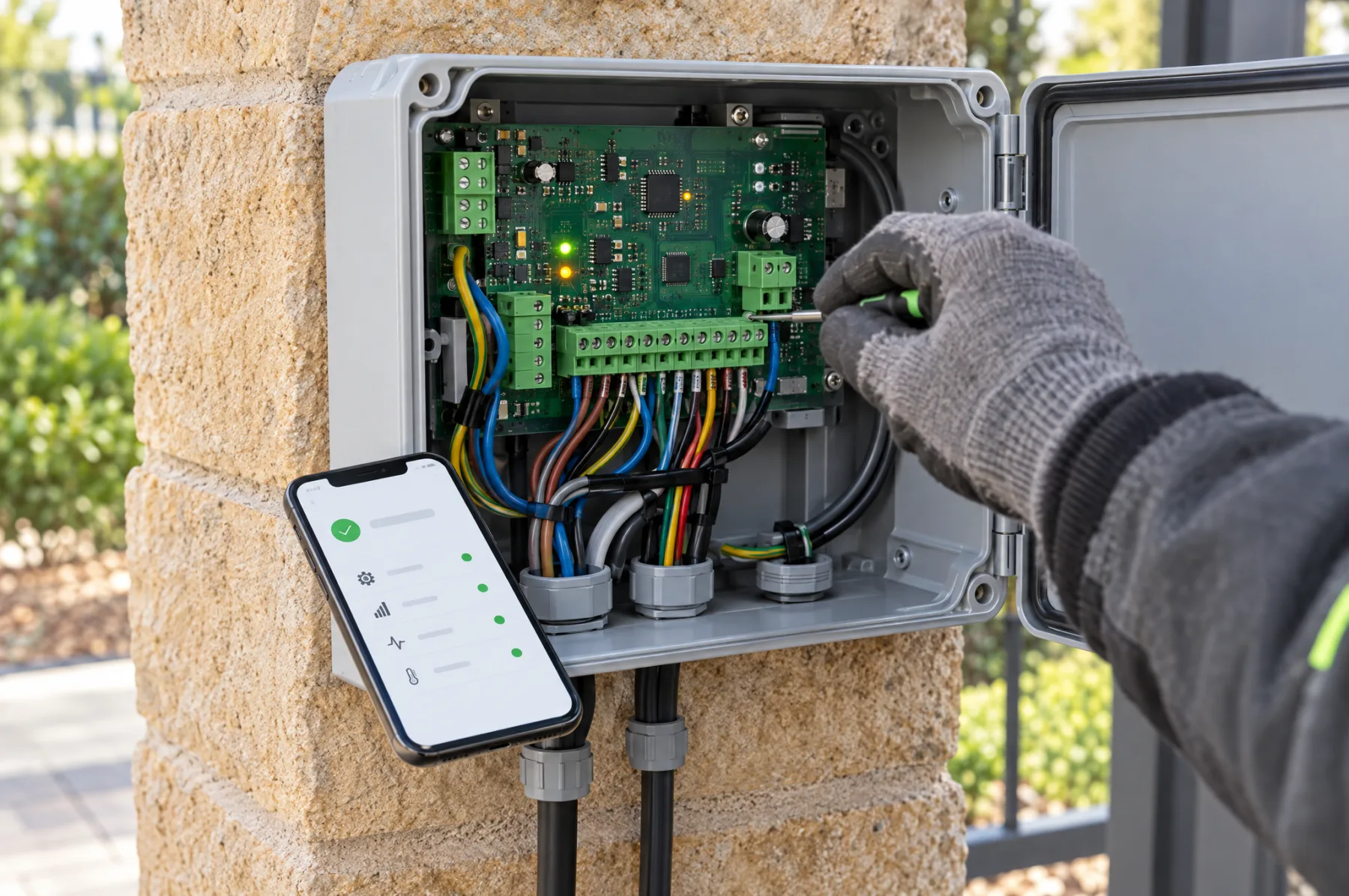
Check the fuse or breaker that feeds the gate, and look for the small LED on the control board through the enclosure window. Storms, garden work and rodents all cut cables. If there is no power at the board, the fault is between the house and the gate.
4. Manual release left engaged
After a power cut someone releases the gate by hand and forgets to lock it back. The motor runs but the gate does not move, or only one leaf moves. Check the release key position on the operator.
5. Force setting too low or friction too high
A gate that starts, stops and reverses with nothing in the way is detecting an obstruction that is not there. Hinges that need grease, a leaf that has dropped and is dragging, or a sliding gate track full of grit all add friction. Do not simply turn the force up: that defeats the safety system. Fix the friction.
6. Capacitor failure
On 230 V operators the motor capacitor fails with age. The symptom is a hum with no movement, or a motor that needs a push to start. It is a cheap part and a quick fix.
7. Limit switches and encoders
If a gate does not know where it is, it will stop short, overrun its stops or refuse to close fully. Limit switches wear and encoders lose their position after power interruptions. Some boards can be re-learned in minutes; worn switches are replaced.
8. Water in the operator
Underground operators and control enclosures flood when drainage was never installed or has blocked. Symptoms are intermittent faults after rain, corroded boards and eventually a dead motor. This is the fault we see most on installations that were done cheaply.
9. Control board failure
Lightning, power surges and simple age kill control boards. Symptoms vary, but a board with burnt components or no LEDs at all with power present is usually the cause. Most boards can be replaced like for like or with a modern universal equivalent.
When to call
If the gate is stuck open, stuck closed with your car inside, off its hinges or behaving erratically, call us on 0141 000 0000. Use the fault finder to tell us the symptom and we will bring the right parts.