Sliding gates for driveways that swing gates cannot serve.
Short drives, steep slopes and wide openings all favour a sliding gate. One leaf travels sideways along the boundary, so nothing swings into the drive. We fit the motor to the weight and the duty.
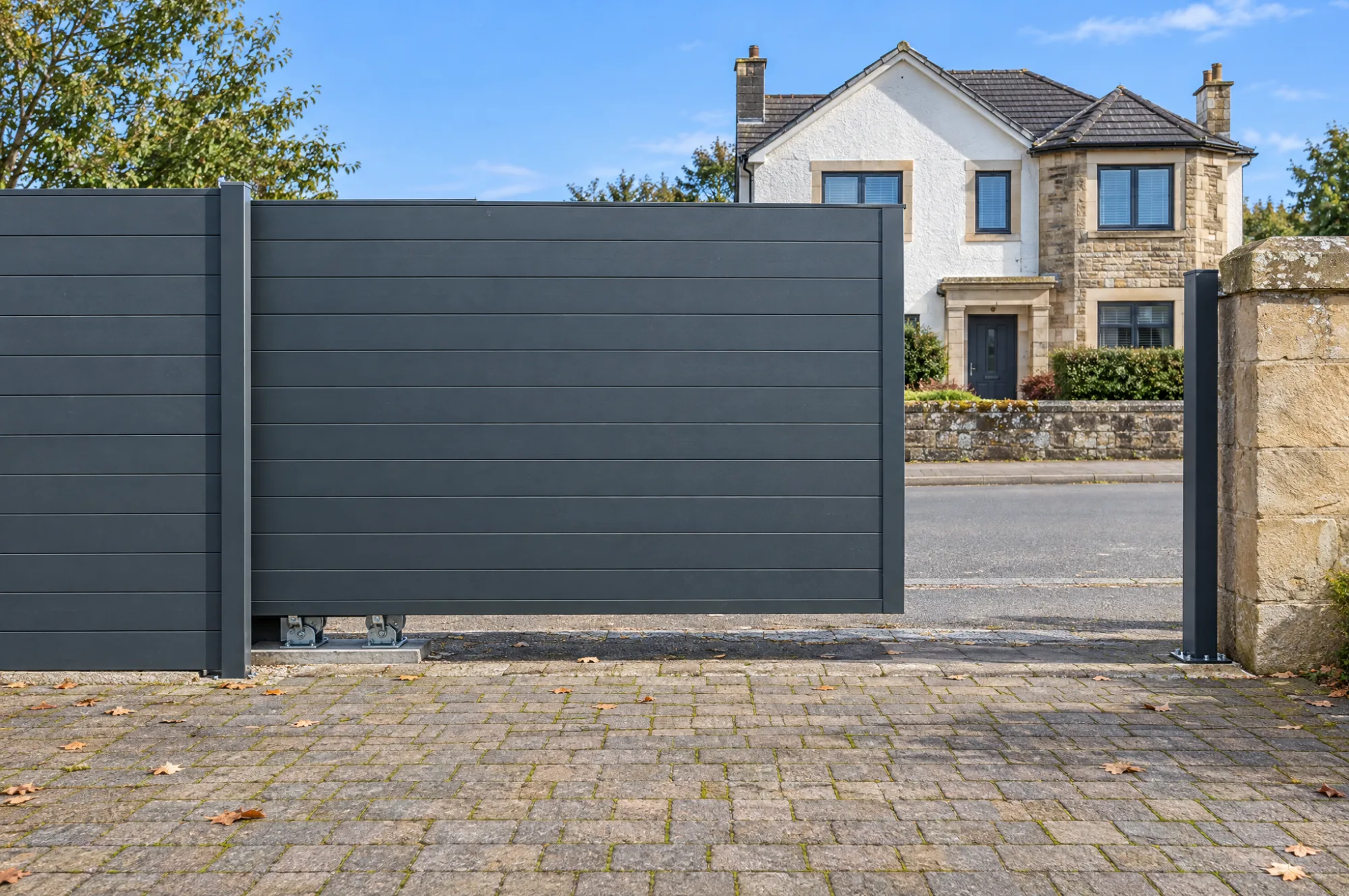
Giffnock. Cathkin, flat panel aluminium sliding gate on a cantilever carriage.
What a sliding gate from us includes.
The leaf is welded, galvanised and powder coated with the counterbalance section and rack built in. We do the groundworks ourselves.
At a glance
- Opening
- 3 m to 12 m single leaf
- Weight
- Up to 2,000 kg
- Run-off space
- Opening + 0.6 m, or + 40 to 50%
- Speed
- 9 to 14 m/min
- Finish
- Galvanised, powder coated
- Lead time
- 5 to 7 weeks from survey
Cathkin, our flat panel aluminium sliding gate, is the one shown above.
Tracked, cantilever and telescopic explained.
The deciding factor is where the open gate lives. Measure the boundary to one side of the opening: that run-off decides which of the three you can have. The figures below are for a 4 m opening.
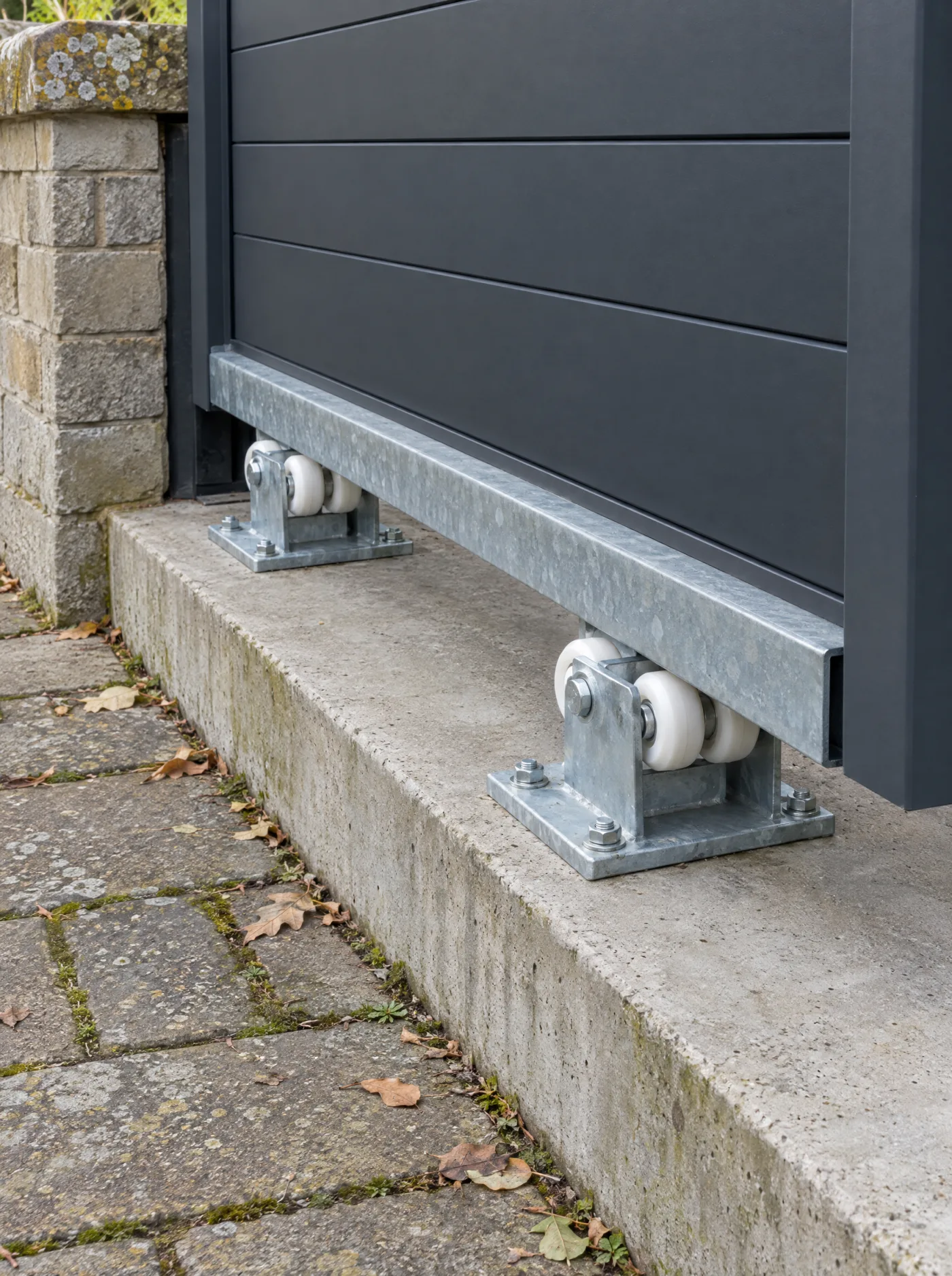
The leaf rolls on wheels along a rail set in the drive. Cheapest and carries the most weight, but the rail collects leaves, grit and ice.
- Run-off
- Opening + 0.6 m = 4.6 m
- Ground
- Level rail bedded on concrete
- Motor
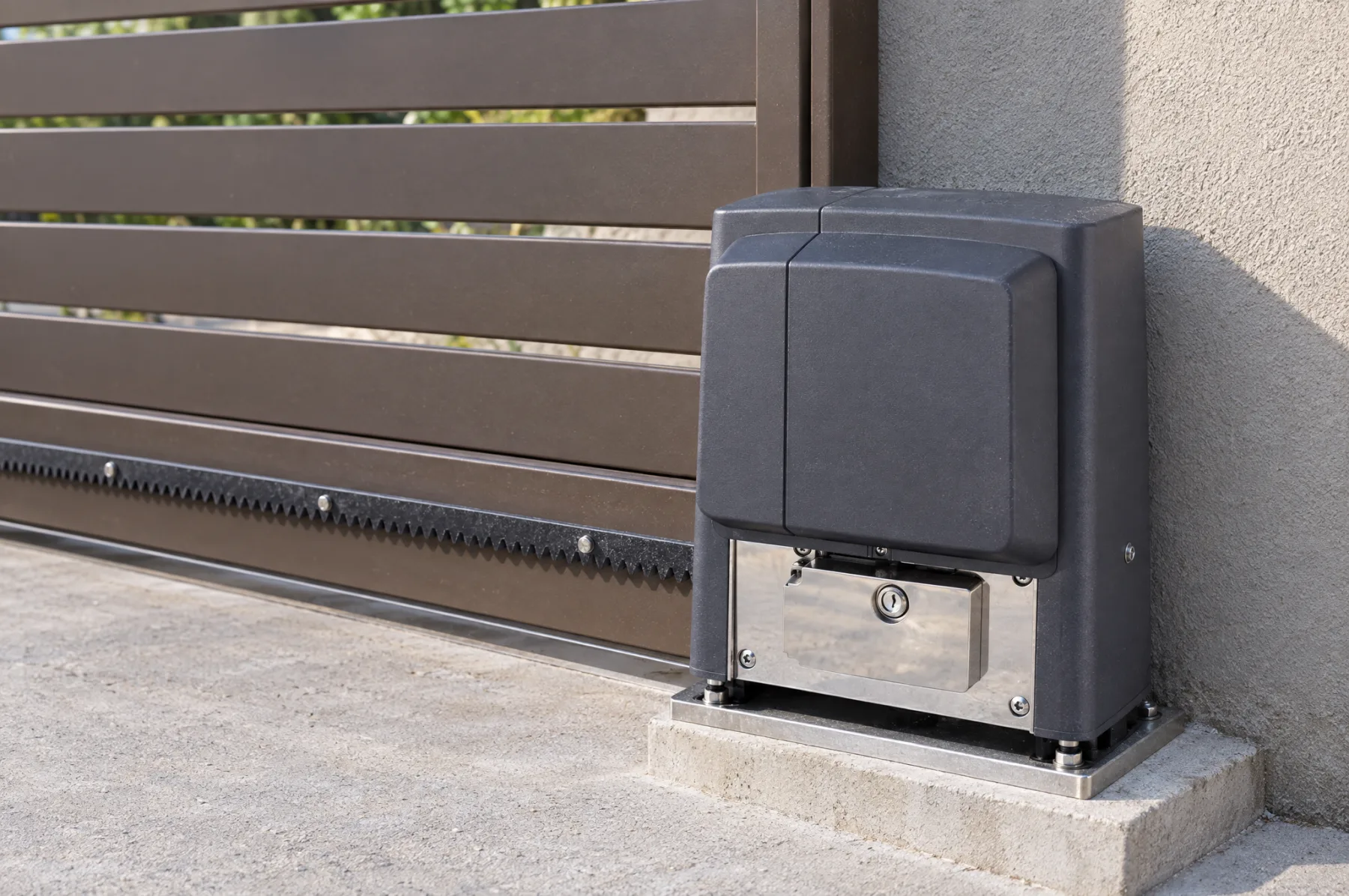
- CAME BX, geared
- Guide price
- from £6,500
The leaf floats above the ground on carriages behind the opening, counterbalanced by its own tail. Right for gravel, snow and anywhere you do not want a track.
- Run-off
- Opening + 40 to 50% = 5.6 to 6.0 m
- Ground
- Concrete footing for the posts
- Motor
- Roger BG30, brushless
- Guide price
- from £8,500
Two nested leaves travel together and stack as they open, so the gate needs roughly half the run-off. For tight sites where nothing else fits.
- Run-off
- Roughly half, about 2.3 m
- Ground
- Tracked or cantilever gear
- Motor
- Two synchronised motors
- Guide price
- from £9,800
From run-off check to commissioning.
- 01Survey and run-off checkThe deciding factor is where the open gate lives. We measure the boundary run-off and check levels, then recommend tracked, cantilever or telescopic.
- 02FoundationsCantilever gates need a substantial concrete footing for the carriage posts. Tracked gates need a level, well-drained rail bedded on concrete. We do the groundworks ourselves.
- 03FabricationThe leaf is welded, galvanised and powder coated with the counterbalance section and rack built in.
- 04Install and commissionLeaf hung, motor set, forces tested, safety devices proven and access controls paired. Two days on site is typical.
Tracked, cantilever or telescopic: the price of each.
Guide prices for a 4 m opening, installed with motor, safety devices and two remotes. The run-off check at survey decides which line applies to you.
- Automated tracked sliding gate4 m opening, steel or aluminium, motor, safety devices, two remotes.
- from £6,500
- Automated cantilever sliding gate4 m opening, including foundations.
- from £8,500
- Telescopic sliding gateTwo-leaf telescopic for short run-off.
- from £9,800
Sliding gate questions.
The three we are asked at almost every survey.
Tracked or cantilever?
Tracked gates are cheaper and carry more weight, but the rail across the drive collects leaves, grit and ice. Cantilever gates float above the ground, so they are the right choice for gravel drives, snow and anywhere you do not want a track, at the cost of more run-off space and bigger foundations.
I only have a little space beside the drive. What are my options?
A telescopic gate splits the leaf into two nested sections that travel together, roughly halving the run-off needed. Alternatively a bi-folding or speed gate can work in very tight sites.
How safe are sliding gates around children?
Correctly installed, very safe. Safety edges on the leading and trailing edges, photocells at two heights, guarded finger-trap zones and a force test are all part of our standard installation, in line with BS EN 12453.
Plan a sliding gate.
Tell us the opening width and how much boundary you have to one side. That decides tracked, cantilever or telescopic.
Monday to Friday, 8am to 6pm. 24-hour emergency callout, seven days.